
Browser Use
The open-source default for browser-controlling AI agents.
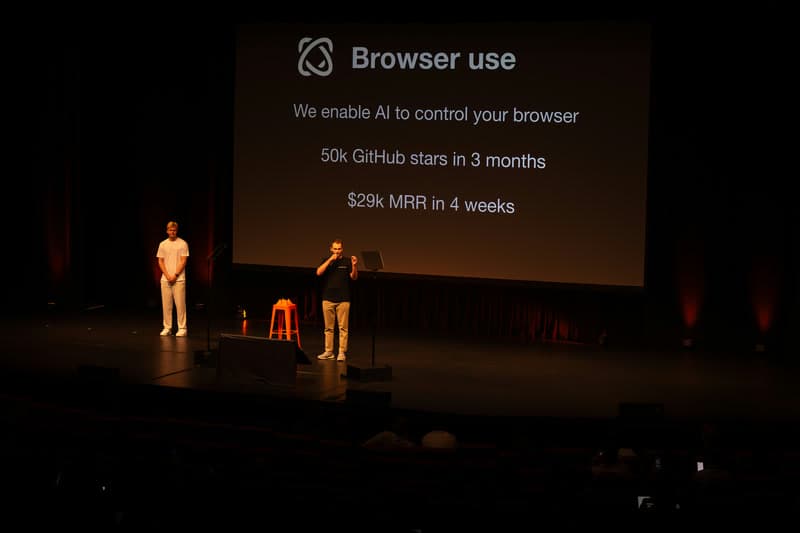
98k+
GitHub stars
From zero in Nov 2024 · 50k by the March 2025 seed · MIT licensed
14%
of YC W25 in production
Default browser-agent harness inside the batch
$17M
Felicis-led seed (Mar 2025)
A Capital, Nexus, YC, Paul Graham, SV Angel
Thesis
- 01
The browser is the universal computer-use surface. Operating systems fragment; the web unifies. Every workflow that matters — Salesforce, Google Workspace, Kayak, Notion, LinkedIn, every internal admin tool — already runs in a browser. When Anthropic shipped Computer Use and OpenAI shipped Operator within three months of each other, they were both betting on the same thesis.[3] [4] The browser is where agents go to do work because the work is already there.
- 02
OSS won this category in months, not years. Browser Use went from launch to 25k stars in its first hundred days by being the cleanest implementation of the thing every agent dev was hacking together. 14% of YC's W25 batch was already in production at memo time.[5] OpenAI Operator is the closed, managed answer; Browser Use is the open one — and 14% of YC W25 chose open.[2] [15]
- 03
The next agent stack is built on Browser Use the same way the last one was built on Playwright. Selenium → Playwright → Browser Use is the same arc. Each step abstracts away the layer underneath. Browser Use is model-agnostic — Claude, GPT, Gemini, DeepSeek, Qwen, and local Ollama all work the same way — so the bet is on the harness, not the model.[6] [13]
- 04
The founders are exactly the right team. Magnus Müller (ETH Zürich, ML researcher, repeat founder, web-scraping hobbyist since he learned to code) and Gregor Žunič (ETH Zürich Data Science MSc, Physics BSc) built the open-source default for what every AI lab is now scrambling to ship. Pivoted from an SEO startup the moment the bigger surface became visible. Shipped Browser Use Cloud within 72 hours of OpenAI's Operator announcement.[7] [9]
Problem
LLMs can think. The web is where they have to act. Every workflow that matters runs behind a UI built for humans.
Every AI agent that does paid work ends up needing to use a browser. Booking a flight, filing a form, reading a SaaS dashboard, posting on LinkedIn, scraping a competitor's pricing page, running a research workflow across ten sites — all of it lives behind interfaces designed for humans, not APIs.
Building that capability in-house is brutal. Selectors break every time a site ships a redesign. Bot-detection systems fingerprint your headless Chrome and block you. Authentication adds friction at every step. Rate limits, parsing errors, and API-key sprawl turn every agent into a maintenance project that nobody on the team wants to own.
The 61% of the web with no public API is exactly the surface where the highest-value agent work happens — and it's the surface that breaks the fastest. The category has been waiting for a Playwright-equivalent primitive — something built for LLM-driven control rather than scripted automation. Browser Use is that primitive.[13]
61%
of the web has no public API
The high-value workflow surface, unaddressed by API-first tools
$5B → $30B
Web RPA TAM (2024 → 2030)
Agent-driven control expands it another 10×
0 → 40k
GitHub stars in 4½ months
Star rate doubled the week Operator launched · 98k+ by June 2026
Browser Use GitHub[2] · GitHub API stargazer log[15] · YC W25 launch post[7]
Why Now
Anthropic shipped Computer Use in October. OpenAI shipped Operator in January. The category opened in front of our eyes.
Three preconditions converged in the same six months: frontier labs validated the browser surface, the harness caught up with the model, and OSS distribution beat closed distribution.
Operator can go to the web and do tasks for you. We think this will be a really big deal — agents that actually do things on the internet.
Sam Altman[4]
CEO · OpenAI
Instead of making specific tools to help Claude complete individual tasks, we're teaching it general computer skills — allowing it to use a wide range of standard tools and software programs designed for people.
Anthropic[3]
Claude 3.5 Sonnet Computer Use
Our vision is simple: tell your computer what to do, and it gets it done.
Magnus Müller[7]
Co-founder · Browser Use
Three preconditions converged in the same six months.
Frontier labs validated computer use. Anthropic shipped Computer Use with Claude 3.5 Sonnet in October 2024.[3] OpenAI shipped Operator on January 23, 2025.[4] Two of the three biggest labs placed the same bet inside a single quarter: the browser is where agents work. The category that didn't exist on YC application day was suddenly the most-discussed surface in the AI stack.
The harness caught up with the model. Browser Use hit 89.1% on the WebVoyager benchmark — state-of-the-art at the time, ahead of OpenAI Operator's 87%.[8] A year ago, none of this worked reliably. Now the bottleneck has moved from "can the model see the page?" to "what's the cleanest abstraction on top?" That second question is the entire venture opportunity, and it's the question Browser Use answers. (An honest postscript: OSU's Online-Mind2Web study later showed the whole WebVoyager generation of scores was inflated — Operator re-measured at 61% under human evaluation. The deflation reset the leaderboard for everyone; it didn't change who had the distribution.[23])
OSS distribution beat closed distribution. When Operator launched in a closed beta available only to $200/month ChatGPT Pro subscribers, developers went looking for the open alternative — Browser Use's starring rate doubled inside a week (15k on January 21 to 20k by January 28, per GitHub's stargazer log) and never slowed: 25k by February 10, 40k by mid-March.[2] [7] [15] Magnus and Gregor were building in public on X the entire time, shipping the cloud version within 72 hours of the announcement. The closed launch became Browser Use's largest distribution event.
Instead of making specific tools to help Claude complete individual tasks, we're teaching it general computer skills — allowing it to use a wide range of standard tools and software programs designed for people.
Eighteen months later: every lab re-validated the bet. None shipped the harness.
OpenAI consolidated, then went consumer. Operator was folded into ChatGPT Agent on July 17, 2025, and retired as a standalone product on August 31.[17] In October, OpenAI shipped ChatGPT Atlas — a full agentic browser, macOS-first.[26] Both are closed, both are OpenAI-model-only, and neither is something a developer can build a product on top of with a different model.
Anthropic and Google followed the same shape. Claude for Chrome entered pilot in August 2025 (1,000 Max subscribers; Anthropic's own red-teaming measured a 23.6% prompt-injection attack success rate, cut to 11.2% with mitigations — a useful public datum on how unsolved the safety layer still is).[18] Google shipped the Gemini 2.5 Computer Use model into public preview in October 2025.[19] Three labs, three model-locked browser-control products in one year. The model-neutral, self-hostable layer remained an open seat — Browser Use's seat.
The curve held the whole way. 70,604 stars in September 2025; 98,462 by June 12, 2026.[25] [15] Salesforce paying to acquire Convergence (May 2025) put an M&A price floor under browser-agent teams; the agentic-browser wave (Comet, Atlas) put consumer marketing dollars behind the category thesis.[20] Demand validation kept arriving from every direction, and the OSS default kept compounding through it.
How It Works
Three layers. One Python import. Any LLM controls a browser.
Open core, managed cloud. Same shape that won Postgres, Next.js, and Kafka their categories.
The OSS core is the install. pip install browser-use, point it at the LLM of your choice, and you're running. MIT licensed, no telemetry tax, no vendor lock-in. The reason 14% of YC W25 is already in production: the integration takes an afternoon.[2] [5]
Browser Use Cloud is the renewal. Proxy rotation, persistent sessions, parallel execution, and a managed control plane at $30/month — vs. $200/month for ChatGPT Pro (the only way to get Operator at launch).[9] The cloud absorbs the operational complexity the OSS version can't.
Model neutrality is the structural moat. Every closed competitor — Operator, Computer Use — is locked to a single model vendor. Every AI engineer building a real product needs fallbacks, cost ceilings, and the freedom to swap models when a new SOTA lands. Browser Use is the only harness that respects that.[6]
The abstraction kept deepening. Browser Use 0.8.0 (October 2025) added an inference gateway that runs trajectories in ~68 seconds — versus 225–330 seconds for the labs' computer-use models at comparable accuracy — priced at $0.50/M input tokens.[21] Skills (April 2026) made agents learn: after a task completes, the system extracts the minimal workflow and shares it across the fleet, so one agent's exploration becomes every agent's shortcut — a single learned Duo-2FA login skill saved redundant work for 254 subsequent agents.[22] And BU Bench (June 2026) — 100 live-web tasks — is the company's bid to own the category's measuring stick after the WebVoyager era deflated.[24]
Speed became the moat the benchmarks undercount
Chart
Seconds per task trajectory at comparable (~65%) Online-Mind2Web accuracy. Browser Use's 0.8.0 inference gateway runs ~68s per trajectory; Google reports ~225s median for Gemini 2.5 Computer Use on the Browserbase harness; Browser Use's published comparison places other computer-use models at up to ~330s.
Source · Browser Use 0.8.0 announcement (Oct 2025) · Google DeepMind (Oct 2025)
The OSS Distribution Story
OpenAI launched Operator. Browser Use's star curve absorbed the news cycle.
The textbook example of how OSS captures demand created by a closed competitor's launch — and the reason Browser Use is now the default browser-agent harness inside the AI cohort.
Zero to 98k stars: the curve that won the category
Chart
Cumulative GitHub stars on browser-use/browser-use (main repo). The starring rate doubled the week Operator shipped (Jan 23, 2025) and never gave the gains back — 40k by mid-March 2025, 70.6k by September 2025, 98.5k by June 2026. Milestone dates from GitHub's per-stargazer timestamps; the Sep 2025 point is an Internet Archive snapshot; the final point is the live API count.
Source · GitHub API stargazer log · Internet Archive (Sep 28, 2025) · GitHub API (Jun 12, 2026)
GitHub API[15] · Internet Archive snapshot[25]
The Operator launch was Browser Use's largest distribution event.
January 23, 2025 — Operator ships behind a paywall. OpenAI announces Operator: closed beta, $200/month ChatGPT Pro requirement, GPT-4o locked, no self-hosting, no enterprise API at launch.[4] Every developer who wanted to ship a browser agent against a non-OpenAI model — or didn't want to pay $200/month — went looking for an alternative.
72 hours later — Browser Use Cloud ships. Magnus and Gregor shipped the managed cloud version of Browser Use inside the news cycle. $30/month entry pricing.[9] Model neutral. Self-hostable. Every Operator limitation became a Browser Use feature on the launch page.
The week after — the star rate doubles. From ~470 stars/day before the announcement to ~900/day in Operator week (15k on January 21 → 20k by January 28, per GitHub's stargazer timestamps), then 25k by February 10 and 40k by March 12.[2] [15] The W25 batch picked Browser Use as the default browser-agent harness. By the seed announcement in March: 50k stars across the org, 15,000+ active developers, 5k Discord members, 500+ contributors.[10] [16] The OSS distribution flywheel is the same one Vercel rode with Next.js, Supabase with Postgres, and Mastra with TypeScript agents — except Browser Use compressed that arc into a quarter.
Two months later — the seed prices the distribution. Felicis led a $17M seed (announced March 22, 2025), with A Capital, Nexus Venture Partners, Y Combinator, Paul Graham, Liquid2, SV Angel, and Pioneer Fund participating.[16] [27] Sixty days from "Operator ships behind a paywall" to a top-tier seed at the center of the hottest category in the batch — the round was effectively priced by the star curve above.
Our vision is simple: tell your computer what to do, and it gets it done.
Market
The densest buyer pool is every AI startup shipping an agent.
Every AI startup shipping an agent ends up needing browser control. YC's W25 batch already adopted Browser Use as the default — 14% in production at memo time.[5] The next ring is the broader Seed-to-Series-B AI cohort: research agents, sales agents, ops agents, coding agents that need to browse. The agent framework boom is mid-cycle; Browser Use sits underneath it as the primitive everyone reaches for.
The long pole is every business workflow that runs in a browser. Web RPA sits at ~$5B today growing to ~$30B by 2030 — and that's just the existing automation pool. The agent layer expands it 10× by making automation viable for the 61% of the web with no API. When agents replace BPO, when every SaaS company ships an agent SKU, when every enterprise has a fleet of agents doing knowledge-worker tasks — Browser Use is the harness underneath.
The market has since started paying for the category in cash, not just stars. Salesforce signed to acquire Convergence — a browser-agent startup eighteen months old — in May 2025 to staff Agentforce.[20] Perplexity shipped Comet at $200/month before taking it free; OpenAI shipped the Atlas browser in October 2025.[26] Consumer browsers, enterprise platforms, and dev tooling are now all converging on the same surface — and each new entrant raises the value of the one model-neutral harness underneath them all.
Every AI agent project is a browser-control project in waiting. Browser Use should be the answer by default — and it is, three months into the curve.
Competitive landscape
Five categories of competition. Browser Use is positioned against all of them.
Each category has a structural limitation — model lock-in, missing harness, missing OSS, or missing AI-native abstraction. Model-agnostic + OSS + Python + Cloud is the answer to all five.
The closed labs ship the agent. The OSS default ships the harness underneath it. Browser Use is the harness — and the harness compounds across model generations the agent never will.
Founder deep dive
Two ETH Zürich engineers who built bots before it was a category — and pivoted the moment the bigger surface arrived.
Founder & team

Magnus Müller
Repeat FounderCo-founder & CEO
Repeat founder. ML researcher and scraping hobbyist since he learned to code. MSc Data Science at ETH Zürich. Published for Cambridge CARES. Built bots, web automations, and process-automation R&D before Browser Use. Saw the gap between LLMs and the web and built the bridge.

Risks & mitigations
What we're watching
References
- [1]Browser Use — Product homepage
- [2]GitHub — browser-use/browser-use (MIT license, 50k+ stars at memo time, 98k+ today)
- [3]Anthropic — Introducing computer use, Claude 3.5 Sonnet (Oct 22, 2024)
- [4]OpenAI — Introducing Operator (Jan 23, 2025)
- [5]Y Combinator — Browser Use company profile (W25)
- [6]Browser Use — Supported models documentation
- [7]Y Combinator Launches — Browser Use: Open-Source Alternative to OpenAI Operator
- [8]Browser Use — State-of-the-art on WebVoyager (89.1% success across 586 web tasks)
- [9]Browser Use Cloud — Hosted version ($30/month vs. $200 ChatGPT Pro for Operator)
- [10]Browser Use Discord — Community (5k+ active members)
- [11]Magnus Müller on X — @mamagnus00 (building in public)
- [12]Gregor Žunič on X — @gregpr07 (building in public)
- [13]Microsoft Playwright — the previous-generation browser-automation primitive
- [14]WebVoyager — Benchmark for vision-language web agents
- [15]GitHub API — browser-use/browser-use live stats and stargazer timestamps (98,462 stars as of June 12, 2026)
- [16]Browser Use — We Raised $17M to Build the Future of Web for Agents (Felicis-led seed, March 22, 2025)
- [17]OpenAI — Introducing ChatGPT agent (July 17, 2025; Operator folded in, standalone retired August 31, 2025)
- [18]Anthropic — Piloting Claude for Chrome (August 2025; prompt-injection attack success cut from 23.6% to 11.2% with mitigations)
- [19]Google DeepMind — Introducing the Gemini 2.5 Computer Use model (October 7, 2025)
- [20]Balderton Capital — AI agent pioneer Convergence to be acquired by Salesforce (May 2025)
- [21]Browser Use — Browser Use 0.8.0, the fastest web agent (October 8, 2025; ~68s per trajectory vs. 225–330s for computer-use models)
- [22]Browser Use — Web Agents That Actually Learn (Skills launch, April 5, 2026)
- [23]Xue et al. — An Illusion of Progress? Assessing the Current State of Web Agents (Online-Mind2Web, COLM 2025)
- [24]Browser Use — BU Bench V1: Claude Fable 5 sets the high score (June 10, 2026)
- [25]Internet Archive — browser-use/browser-use repo snapshot, September 28, 2025 (70,604 stars)
- [26]OpenAI — Introducing ChatGPT Atlas (October 21, 2025)
- [27]SiliconANGLE — Browser Use raises $17M to help steer AI agents through the internet (March 23, 2025)